
Can you replace just the wing mirror glass?
Yes. On most cars you can replace just the wing mirror glass, and often just the painted cover, without buying a whole new mirror. Replacement glass usually comes on its own backing plate, and heated, auto-dimming or blind-spot-warning glass has its own connectors, so match the exact type and side. If the housing, base, motor or folding mechanism is damaged, a complete mirror unit in the right colour is often the more sensible fix. Start with your make, model and the part number from the old mirror, then compare options.
Glass, cover or whole unit: what's actually broken?
Look at the mirror closely before you buy anything. Most wing mirrors are built from separate parts that can be replaced on their own:
| What you can see | Likely part | Notes |
|---|---|---|
| Cracked, shattered or missing reflective glass, but the mirror still moves when you adjust it | Glass (with its backing plate) | The most common and simplest repair |
| Scratched, cracked or missing painted cap on the back of the mirror | Cover (also called a cap or scalp) | Needs the right shape and colour |
| Cracked or missing indicator lens on the mirror | Indicator lens or indicator unit | Check whether the lens and bulb/LED come as one part |
| Mirror flops about, sags or is hanging off | Base, housing or complete unit | Usually the mounting or internal frame has broken |
| Electric adjustment, folding or heating doesn't work | Motor, wiring or complete unit | Check the fuse and switch first |
| Camera, puddle light or blind-spot warning light not working | Complete unit or the specific module | These parts vary by trim level |
If the mirror was hit hard, check the base and the door around it as well. A mirror that looks fine but moves when you touch it has a broken mounting. New glass won't fix that.
Replacing just the glass (clip-on vs glued, heated vs non-heated)
Clip-on glass. On most modern cars the glass is bonded to a plastic backing plate that clips onto the adjuster behind it. You carefully ease the old glass off, unplug any heater wires and press the new plate on until the clips engage. Replacement glass for these cars is normally sold already fitted to a new backing plate.
Glued or self-adhesive glass. On some older cars, and with some aftermarket glass, the new glass sticks onto the existing backing plate with adhesive pads. This only works if the old plate and its clips are undamaged.
Heated or not heated. Heated glass has two small terminals on the back of the plate. If your car has heated mirrors, buy heated glass with the same connections. Unheated glass will fit some cars but the demister won't work.
Other features built into the glass:
- Auto-dimming (electrochromic) glass darkens at night and has its own wiring.
- Blind-spot warning lights are built into the glass on some cars.
- Aspheric glass has an outer section, often marked with a dashed line, that curves more to widen the view.
Left and right are different. Glass for the driver's side and the passenger side isn't interchangeable. The shape differs and the curvature can differ too. Glass from a left-hand-drive car may also not suit a UK car.
Safety when fitting. Wear gloves and eye protection, because broken mirror glass is sharp. Keep the backing plate supported while you work so you don't snap the adjuster behind it. Follow any instructions supplied with the part. If the adjuster or clips are broken, the glass won't sit steady, and that needs a different repair.
Replacing the cover or indicator
Covers usually clip or screw onto the mirror housing. They're sold either primed (ready to paint) or already painted. A used cover from the same model and generation in the same colour can save a trip to the paint shop. Colour can still vary with age and fading, so ask for current photos taken in daylight.
To match the colour, use your car's paint code, not the colour name. Two cars described as "silver" can have quite different paints. See the FAQ below for where to find the code.
Indicators. Many mirrors have an indicator repeater built into the housing. Some cars let you replace just the lens; on others the lens and lamp are one unit. Note the exact part number from the old unit. If the indicator doesn't work after a knock, check the wiring connection inside the mirror before buying parts.
When a complete unit makes more sense (motor, folding, blind-spot sensors)
A complete mirror unit is usually the better route when:
- the base or housing is cracked, or the mirror is loose on the door
- the adjustment motor or power-folding motor has failed, and the motor isn't sold separately for your car
- several parts are damaged at once (glass, cover, indicator and frame), so buying them one by one adds up
- the mirror carries cameras or sensors for surround-view or blind-spot systems, where matching the exact specification matters
Fitting a complete unit is more work than changing the glass. On many cars you have to remove a trim panel inside the door to reach the mounting bolts and the electrical connector. If the mirror carries a camera or is part of a driver-assistance system, ask the supplier or a specialist whether it needs setting up after fitting.
Buying a used mirror: colour codes, left vs right, connector types
A used mirror from the same model can be a good-value fix, but only if it matches. Before you buy, check:
- Side. In the UK, the nearside is the left-hand side of the car (the passenger side on a right-hand-drive car) and the offside is the right-hand side (the driver's side). Say "left" or "right" as well as nearside or offside, viewed from the driver's seat, to avoid mix-ups.
- Model and generation. The same model name can cover several generations with different mirrors. A registration helps identify the car but doesn't confirm the part, so compare the part number too.
- Features. Manual or electric adjustment, heating, power folding, indicator, puddle light, camera or blind-spot warning. Mirrors from different trim levels of the same model often differ.
- Connector. Compare the plug shape and which pins are actually used, not just the number of pins. Two plugs can look identical but be wired for different features.
- Colour. Check the paint code, or plan to buy a primed cover and have it painted.
- Condition. Ask for photos of the actual item: glass, cover, mounting base, plug and clips. Ask which functions have been tested (adjustment, folding, heating, indicator).
- Terms. Get the total price including VAT and delivery, plus the returns and any warranty terms, in writing from the supplier.
We haven't given prices, because they depend on the car, the part and its condition. Compare quotes for your exact part.
Using Spare Car Part to find one:
- Browse car parts free: more than 10,000 OEM catalogue references across 12 car-part categories, including body panels, to help you identify the part and its number.
- Used car parts by make and model, and make pages such as Toyota parts.
- If you have a Toyota Yaris, our page on used Yaris wing mirrors covers the Yaris generations and the details suppliers need.
- Request a part: give your registration and the part you need, and we'll check with UK breakers and parts suppliers and email you any quotes. An enquiry doesn't guarantee a quote, and online purchasing on Spare Car Part is temporarily unavailable.
- The free UK breaker yards directory lists breakers you can contact yourself. It doesn't cover every yard, so phone first to check they have the part.
For more on choosing between part types, see OEM, aftermarket and used parts: how to compare and Used or new car parts: how to compare.
Is a broken wing mirror an MOT fail?
It depends on how badly it's damaged and whether the mirror is one your car must have. The DVSA MOT inspection manual (section 3.3, "View to rear") tells testers to check that all mandatory rear-view mirrors or indirect vision devices give an adequate view to the rear from the driver's seat. It grades mirror defects like this:
| MOT defect (obligatory mirror or device) | Category | Result |
|---|---|---|
| Missing | Major | Fail |
| Slightly damaged or loose | Minor | Pass, with the minor defect recorded |
| Inoperative, excessively damaged or insecure | Major | Fail |
| Not providing an adequate view to the rear | Major | Fail |
The manual's introduction explains that a vehicle with only minor defects passes and gets a certificate, while any major or dangerous defect means a fail.
Which mirrors are obligatory? For cars (passenger vehicles with fewer than 8 passenger seats), the MOT manual says:
- first used on or after 26 January 2010: three mirrors or devices: offside exterior, nearside exterior and interior, unless the interior mirror gives no view to the rear
- first used from 1 August 1978 to 25 January 2010: two mirrors or devices, one of which must be the offside (driver's side) exterior mirror
- first used before 1 August 1978: at least one mirror or device
Additional interior mirrors aren't part of the test. On some vehicles, cameras (indirect vision devices) replace mirrors, and the tester then inspects the camera and the screen. Separately, a damaged or tinted windscreen or window that blocks the driver's view of an obligatory exterior mirror is its own MOT defect.
What the MOT data shows
We analysed DVSA's anonymised MOT data for 2025 and repeated the analysis on 2024. Counts are MOT tests, not cars: some cars are tested more than once.
- 40,956 MOT tests on cars and light vans in 2025 had at least one rear-view mirror failure item. That's 0.45% of the 9,180,835 tests that failed first time (about 1 in 224), and 0.12% of all 33,144,908 tests. In 2024 the figure was 47,099 tests (0.50% of 9,350,985 initial failures).
- The most common mirror failure was "seriously damaged, affecting the rear view", on 19,163 tests (46.8% of tests with a mirror failure). Next came "insecure" (9,494; 23.2%), "missing" (8,134; 19.9%) and "does not provide a view to the rear" (4,992; 12.2%). One test can have more than one mirror item, so these shares add up to more than 100%. 2024 showed the same order.
- Driver's side slightly more often than passenger side. Mirror failure items were recorded on the offside (driver's side) on 19,890 tests (48.6%) and on the nearside (passenger side) on 17,894 tests (43.7%). 2024 was almost identical (48.9% and 43.9%).
- For about 1 in 6, the mirror was the only problem. On 6,299 tests (15.4% of tests with a mirror failure), every failure item was a mirror item. In 2024 it was 7,218 (15.3%).
- Most were not fixed on the spot. On 6.4% of tests with a mirror failure (2,632), all the mirror items were repaired at the test station within an hour (recorded as "PRS"). On the rest, at least one mirror item was a straight fail.
- Minor damage is far more common than failures. 163,402 tests in 2025 recorded a mirror as "slightly damaged" or "slightly loose". That's a minor defect, so on its own the car still passes. That's roughly four minor mirror defects for every mirror failure (3.5 in 2024).
- Older cars fail on mirrors more often. Among cars that failed first time, a mirror failure item appeared on 0.35% of failures at 3 to 5 years old (2,679 of 772,155), against 0.63% at 21 years and older (3,368 of 531,417). 2024 shows the same rise (0.40% to 0.70%).
- No mirror failure item in either year was graded "dangerous".
Expert Car Check analysis of DVSA anonymised MOT data, 2025 (with 2024 replication). Contains public sector information licensed under the Open Government Licence v3.0.
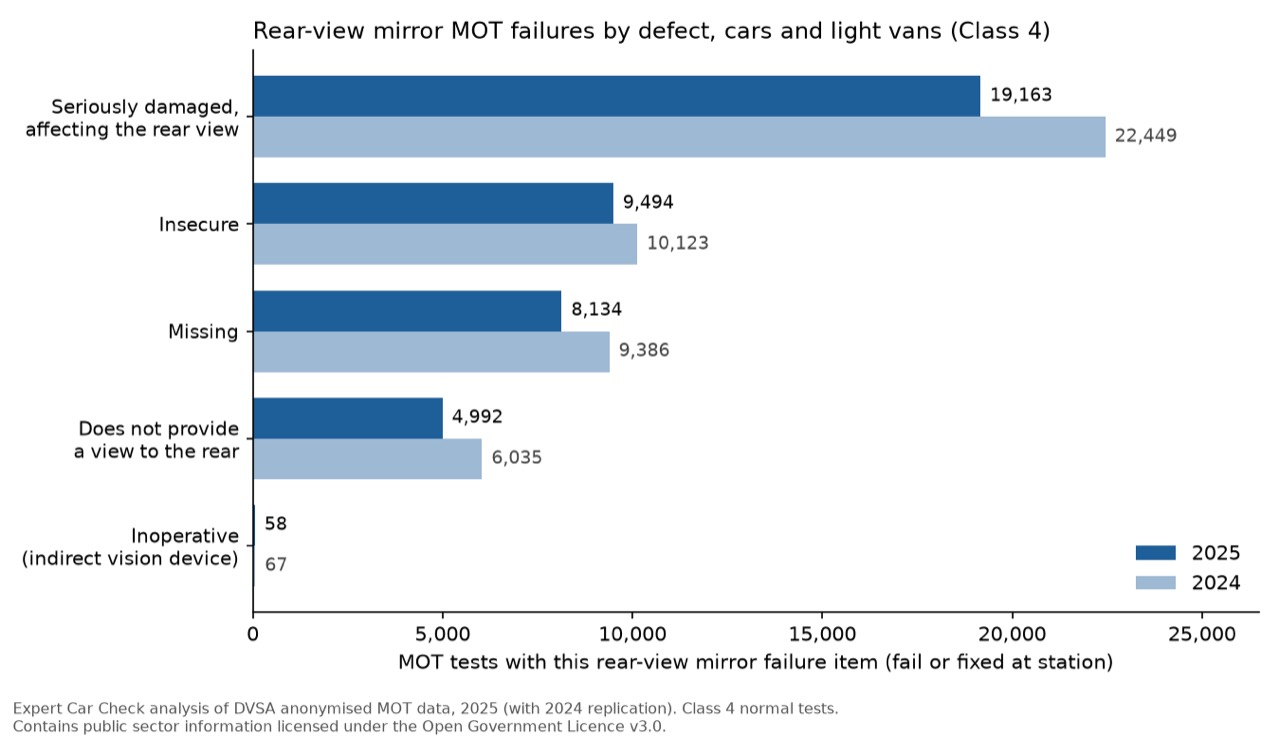
Chart: our own analysis of DVSA anonymised MOT data, Class 4 normal tests, 2025 and 2024.
How we worked this out. The data is DVSA's "MOT Anonymised Data" (anonymised MOT tests and results), published on DVSA's open data site and last updated on 22 June 2026. We downloaded the 2025 and 2024 files on 27 September 2026 and ran this mirror analysis on 5 October 2026. We included Class 4 vehicles (cars, taxis, private hire vehicles and light goods vehicles up to 3,000 kg) and normal first tests only, with a result of pass, fail or pass after rectification at the station. Retests and abandoned tests were left out, as were records with an impossible first-use date or no make or model. A "mirror failure item" is any failure or PRS item from the "Mirrors" or "Indirect vision devices" items under "View to rear" in DVSA's defect list. Windscreen damage that blocks the view of a mirror was counted separately (5,281 tests in 2025) and isn't in the figures above. Driver's or passenger side comes from the location the tester recorded. The 2025 file has no tests dated 31 December 2025 (about 0.1% of a year's tests), which is why we repeated everything on the complete 2024 file. Percentages are rounded to one decimal place, or two where the number is very small.
What this means for you. A chipped or slightly cracked glass is usually a minor defect, so it won't fail the MOT on its own, but it's still worth replacing so you can see properly. A mirror that's smashed, hanging loose or missing is a major defect and a fail. Fix it before the test, ideally as soon as you can.
Frequently asked questions
Is it legal to drive with a broken wing mirror?
Your car must have the mirrors the law requires for its type and age. These are set out in regulation 33 of the Road Vehicles (Construction and Use) Regulations 1986 for England, Scotland and Wales. Regulation 33 also says that, on many vehicles, each exterior mirror must be visible to the driver through a side window or the swept part of the windscreen. The Highway Code (rule 161) says you should use all your mirrors throughout your journey, and Annex 6 tells you to make sure your mirrors are adjusted correctly before you drive. If a mirror your car needs is missing, or so damaged that it no longer gives you a proper view behind, get it replaced before you drive any distance. It will also fail the MOT (see above). A small chip that doesn't affect the view is treated as a minor defect at the MOT.
Is nearside the passenger side in the UK?
Yes, on a right-hand-drive UK car. UK road law describes the left of the vehicle as the "near side" (the side next to the kerb when you drive on the left), so the nearside mirror is the passenger-side mirror and the offside mirror is the driver's side. On a left-hand-drive import, driver and passenger are reversed, so always say left or right as well.
Will a mirror from another trim level fit?
Sometimes, but don't assume it will. Mirrors on the same model and generation often share a mounting, but trim levels differ in heating, power folding, indicators, puddle lights, cameras and blind-spot warning lights, and the connector can be wired differently. Match the part number from your old mirror, compare the plug and pins, and get the supplier to confirm fitment in writing.
How do I find my paint code?
The paint code is usually printed on a label or plate on the car, often in a door frame, under the bonnet or inside the boot. The exact place varies by manufacturer, so check your handbook. A franchised dealer can also look it up from your VIN. The colour name on your V5C logbook isn't enough to match paint.
Can I fit it myself?
Clip-on glass is usually a simple DIY job if the adjuster behind it is undamaged and you work carefully with gloves and eye protection. Covers are often straightforward too. A complete unit takes more work, because on many cars you remove a door trim panel to reach the bolts and the wiring. Get professional help if the mirror has cameras or driver-assistance sensors, or if you're not confident working on door trims and wiring.
Sources
Accessed 5 October 2026:
- MOT inspection manual: cars and passenger vehicles, section 3: Visibility (3.3 View to rear) (DVSA, GOV.UK). Page updated 1 June 2026.
- MOT inspection manual: cars and passenger vehicles, introduction (defect categories) (DVSA, GOV.UK)
- Road Vehicles (Construction and Use) Regulations 1986, regulation 33: mirrors and other devices for indirect vision (legislation.gov.uk)
- The Highway Code, using the road (rules 159 to 203), rule 161: mirrors (GOV.UK)
- The Highway Code, Annex 6: vehicle maintenance, safety and security (GOV.UK)
- Road Vehicles Lighting Regulations 1989, regulation 24 ("left or near side") (legislation.gov.uk)
- MOT Anonymised Data (DVSA open data). Last updated 22 June 2026; files downloaded 27 September 2026.
- Anonymised MOT tests and results (data.gov.uk)
- MOT testing data user guide, v5.1 (DVSA)
- Open Government Licence v3.0 (The National Archives)
More guides